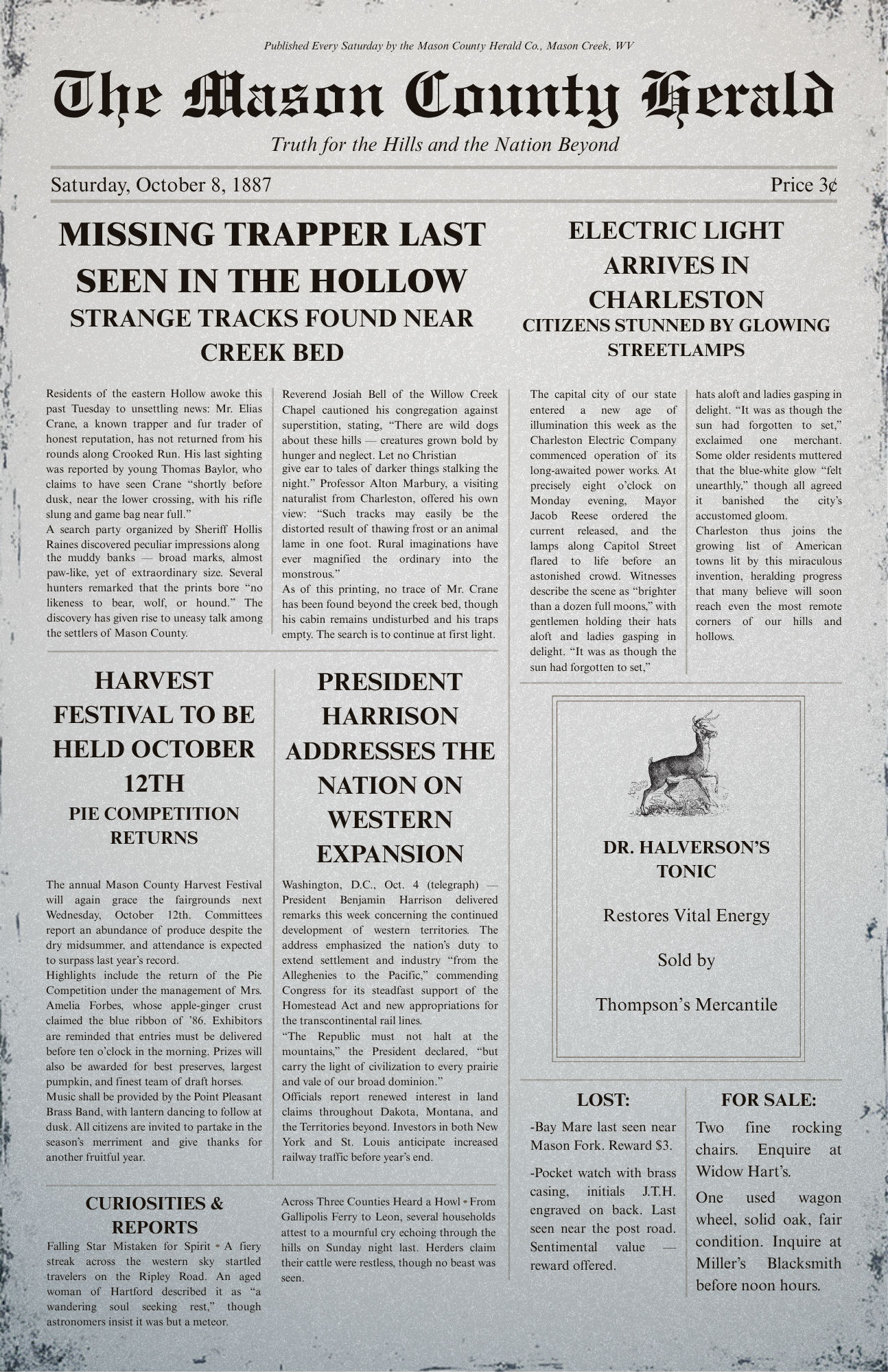
1887 — The Mason County Herald
Presents early accounts of the phenomenon framed as superstition and unexplained violence. Establishes the myth before it is understood.
A werewolf survival horror project built around isolation, folklore, environmental tension, and layered narrative design. My contribution focused on world-building, narrative structure, supporting gameplay systems, and foundational development documentation.
← Back to PortfolioThis case study focuses on the narrative systems, documentation, and creative problem-solving I developed for the project.
The work demonstrates how I structure atmosphere, progression, lore, support systems, and player-facing narrative elements for an interactive horror experience.
“On a cursed Appalachian farm, you are hunted by a sadistic werewolf — your own uncle — and haunted by the ghosts of its victims. Over five nights, you uncover the generational curse… You must balance survival, crafting, and discovery to cleanse yourself and the land — or become the beast.”
The narrative is structured across five escalating acts: Arrival, Realisation, Descent, The Trap, and The End. Each phase progressively blends survival mechanics with psychological pressure.
The game’s pacing is built around a day/night loop where exhaustion is a lived mechanic rather than a forced timer.
“Sleep deprivation, panic, and physical breakdown are gradual, believable, and horrifying.”
Audio logs were designed as optional narrative rewards that track the uncle’s psychological collapse.
Early tone: rational, grounded explanations of events.
Mid tone: fear and confusion.
Late tone: guilt and acceptance.
“I locked myself below ground. I thought it would help… It’s not the beast you have to fear. It’s the land.”
The central conflict is built on a generational curse originating in 1693, where a family pact binds one member each generation to become the “wolf of the hollow.”
The land itself is sustained through sacrifice, meaning survival mechanics are directly tied to narrative consequence.
Instead of relying purely on direct exposition, I created artefacts that allow the world to tell its own story through time.
Presents early accounts of the phenomenon framed as superstition and unexplained violence. Establishes the myth before it is understood.
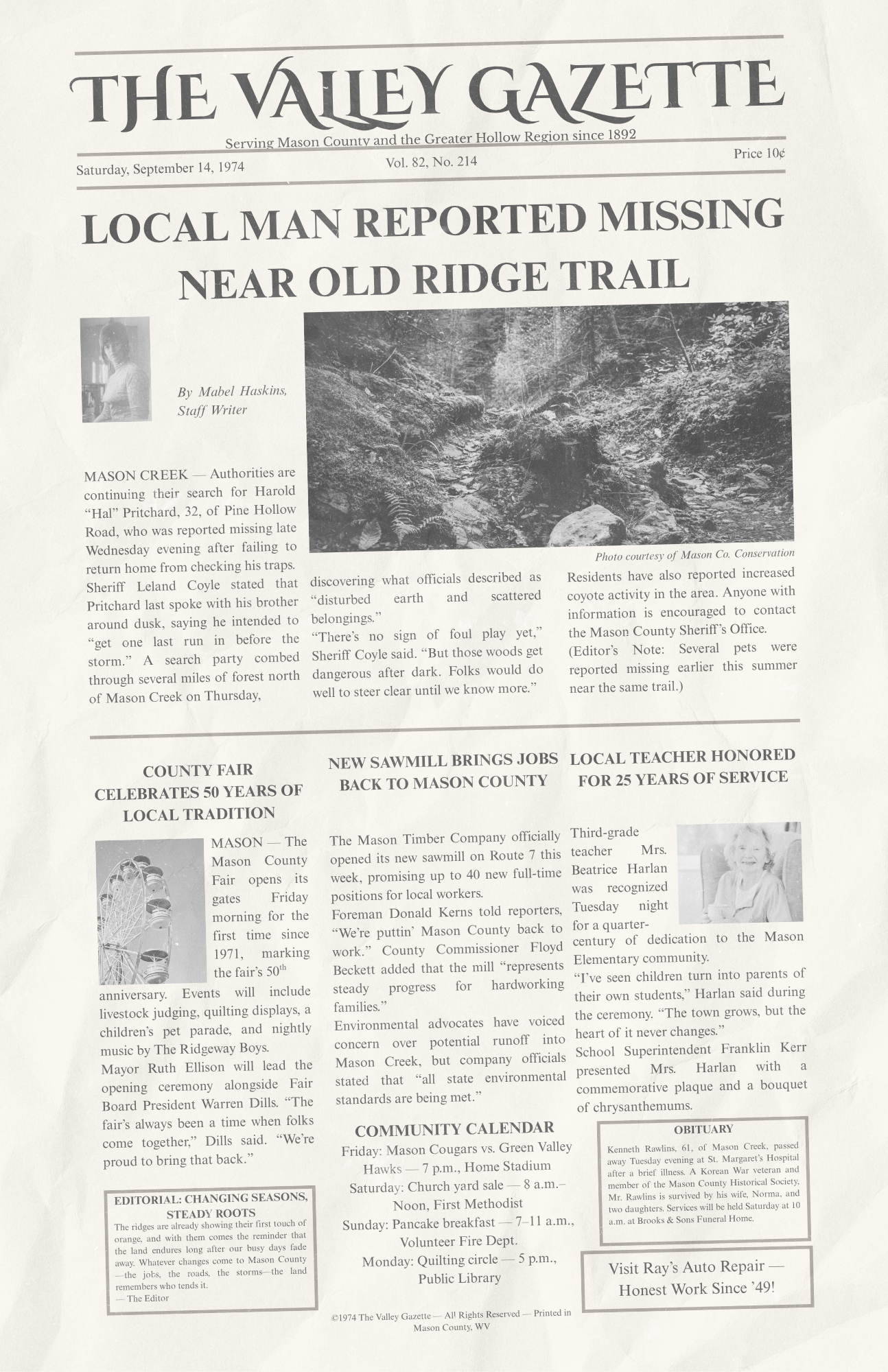
A more modern perspective, reframing events as missing persons cases while still hinting at something unnatural beneath the surface.